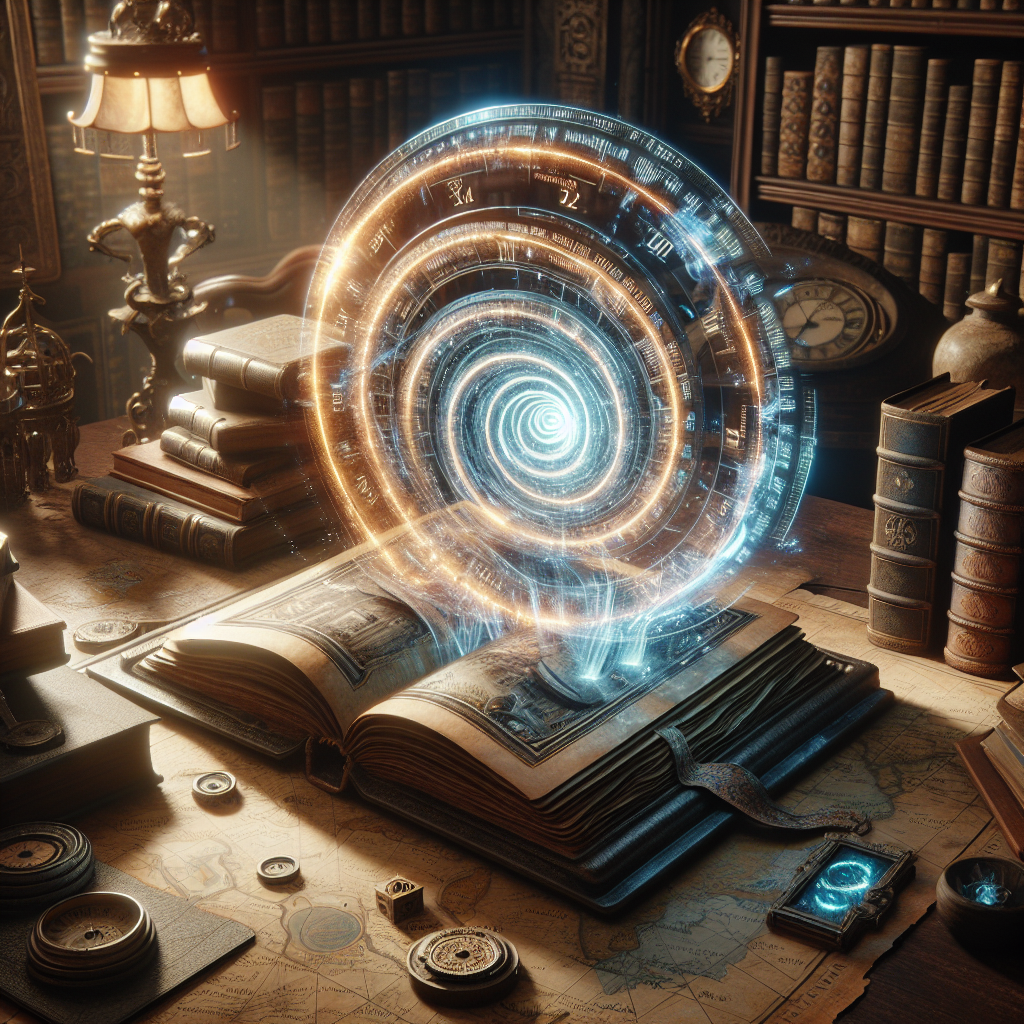
The Chronos Codex: A Temporal Anomaly in Miniature
The air hung thick and heavy, a suffocating blend of ozone and impending rain. But this wasn’t the clean, electric tang of a summer storm. It was something else, acrid and unsettling, like the smell of burnt circuits and fractured timelines. I checked my watch, though I knew it was pointless. Time here was a shattered mirror, reflecting only fragmented images of what was, what is, and what might never be.
I found him hunched in the corner of the abandoned clock tower, a wiry figure swallowed by shadows. He clutched a leather-bound book, its pages brittle and yellowed. The Chronos Codex, they called it – a compendium of temporal anomalies, paradoxes etched in ink that seemed to shift and writhe under the dim light.
“You shouldn’t be here,” he rasped, his voice like dry leaves skittering across pavement. “This place…it bleeds time.”
I ignored his warning, drawn closer by an invisible force. The Codex pulsed with a faint, ethereal glow, beckoning me into its labyrinthine depths. I reached out, my fingers tracing the faded script.
“Don’t!” he shouted, lunging forward. But it was too late. My touch had broken the seal, unleashing a torrent of temporal energy. The tower groaned, the gears grinding against each other in a cacophony of mechanical anguish.
The room dissolved, reality unraveling around us like a poorly woven tapestry. I saw flashes of other times, other places – Roman legions marching through futuristic cities, dinosaurs grazing on neon-lit landscapes, Victorian gentlemen sipping tea on the surface of Mars.
The Paradox Engine
The Codex was a paradox engine, a self-perpetuating loop of cause and effect. Every attempt to understand it only deepened the mystery, every intervention only amplified the chaos. It was a trap, a beautifully crafted prison of temporal recursion.
“We’re trapped,” the old man wheezed, his eyes wide with terror. “Doomed to relive this moment, again and again, forever bound to the Codex.”
I looked at him, his face etched with resignation. Was he a prisoner too? Had he made the same mistake, countless iterations ago? Or was he simply a fragment of the Codex itself, a guardian of its secrets?
Suddenly, an idea sparked in my mind, a flicker of hope in the temporal storm. The Codex was a loop, but loops could be broken. We just needed to find the right point of intervention, the precise moment to disrupt the cycle.
I focused my attention, trying to visualize the flow of time, to map the labyrinthine pathways of cause and effect. It was like trying to navigate a river of quicksilver, constantly shifting and reforming.
“The Codex,” I said, my voice barely a whisper. “It feeds on intention. On the desire to understand, to control. What if we simply…let go?”
A Leap of Faith
The old man stared at me, his expression a mixture of disbelief and cautious optimism. “Let go? But…”
“We have nothing to lose,” I interrupted. “Every attempt to fight it only strengthens its hold. We have to surrender, to embrace the chaos. Only then can we escape.”
He hesitated for a moment, then nodded slowly. Together, we closed our eyes and emptied our minds, releasing our grip on the present, on the past, on the future.
The temporal storm intensified, the Codex vibrating with unrestrained power. I felt myself being pulled in a thousand different directions, my sense of self dissolving into the maelstrom.
Then, silence.
I opened my eyes. The clock tower was gone. The Codex was gone. The old man was gone. I stood on a windswept hill, the sun warm on my face. The air smelled clean and fresh, like rain after a long drought.
I had escaped. But at what cost? Was this a new reality, or simply another iteration of the loop, a slightly altered version of the same temporal prison? I couldn’t be sure.
I looked up at the sky, the infinite expanse of blue stretching out before me. Perhaps some questions are best left unanswered. Some mysteries are too dangerous to unravel. Sometimes, the only way to win is to walk away.
