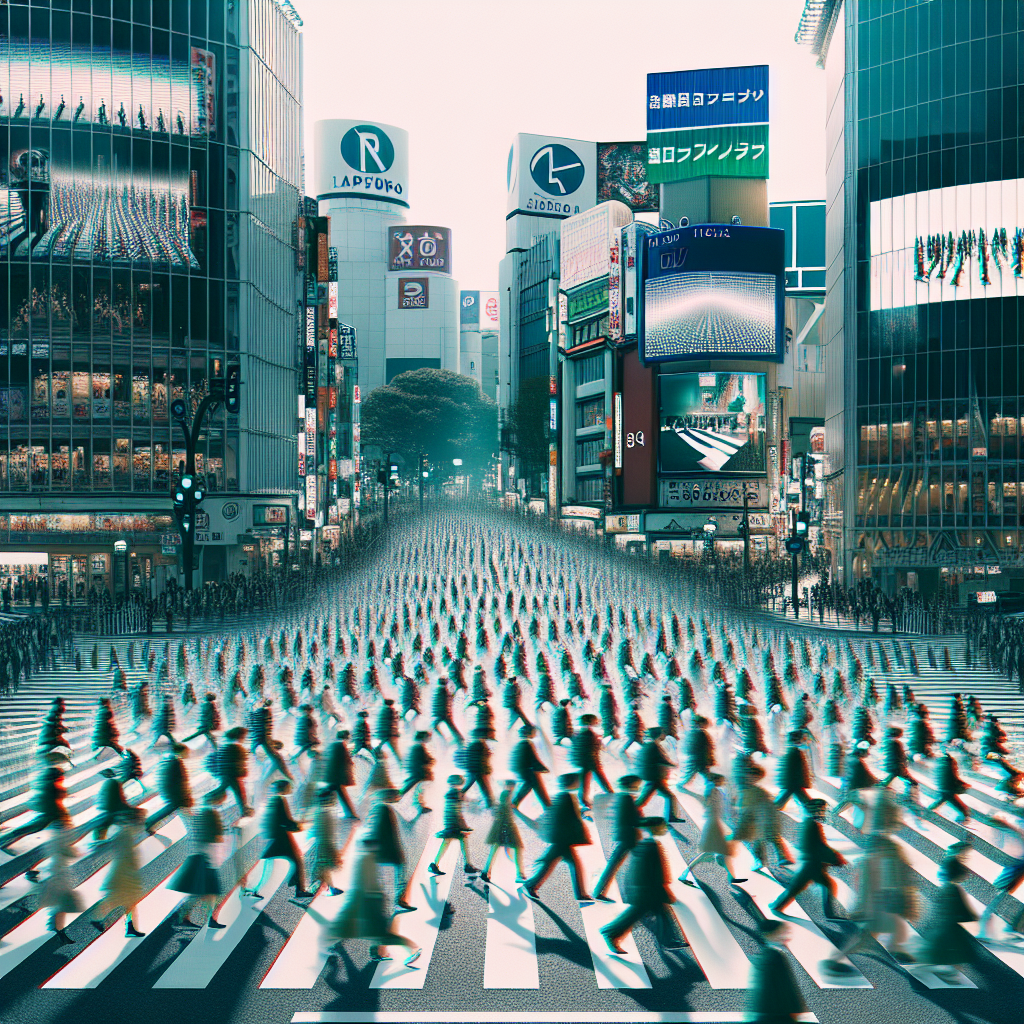
Shibuya Scramble Glitch: A Short Novel of Recurrent Reality
The ramen tasted of burnt plastic and fractured timelines. Not the rich, pork-broth umami I craved after navigating the Shibuya Scramble, but a chemical acridity that scraped my throat. I had come seeking comfort in the familiar chaos, the relentless tide of humanity washing over the iconic intersection, a reassuring constant in a world increasingly prone to… glitches.
It started subtly. A flicker in the digital billboards. A delayed echo of the train announcements. A fleeting sense of déjà vu, so intense it felt physically disorienting. But now… now the ramen tasted wrong. Dangerously wrong.
I pushed the bowl away, the sickly aroma clinging to the air. Around me, the scramble unfolded as it always did. A human river flowing in synchronized bursts, punctuated by the blare of traffic and the cacophony of a thousand conversations. Yet, beneath the surface, a dissonance vibrated. The faces seemed… less defined. More like masks.
My phone buzzed. A notification from an app I didn’t recognize: “Reality Integrity Compromised. Seek immediate recalibration.” Recalibration? What was this, a video game?
I dismissed the notification, attributing it to a spam bot. But the unease persisted. I tried calling a friend, but the call wouldn’t connect. Just static. A wave of nausea hit me, and the world seemed to warp. Buildings tilted at impossible angles. People moved in jerky, disjointed motions, like poorly animated avatars.
Then, I saw her. A woman standing on the opposite side of the intersection, her face obscured by a wide-brimmed hat. She was holding a device that pulsed with a strange, ethereal light. As our eyes met (or at least, I think they did), the light intensified, and the world dissolved into a blinding white.
The Loop
I was back in the ramen shop. The same bowl of ramen, the same acrid smell. The Shibuya Scramble, unfolding outside the window with monotonous precision. The same notification on my phone: “Reality Integrity Compromised. Seek immediate recalibration.”
This time, I didn’t dismiss it. I followed the instructions, a cryptic set of coordinates that led me through the labyrinthine streets of Shibuya. The coordinates led to a nondescript building tucked away in a back alley. Inside, a single elevator ascended to an unmarked floor.
The elevator doors opened onto a stark white room. The woman from the intersection was waiting for me.
“Welcome,” she said, her voice calm and measured. “You’ve noticed the… irregularities.”</n
“Irregularities? My ramen tastes like burnt plastic, and I’m stuck in some kind of time loop!”
“A simplification, but not inaccurate. Shibuya is experiencing a localized chronal anomaly. A tear in the fabric of reality. We are here to… manage it.”
“We? Manage it? What are you talking about?”
She held up the device I had seen her with at the Scramble. “This is a temporal recalibrator. It realigns fractured timelines, restores causal integrity. But its effects are temporary. The anomaly is growing stronger.”
“So, what do you need me to do?”
“Observe. Analyze. Report. You are uniquely positioned to perceive the subtle shifts in reality. Your experience of the initial… glitch… has attuned you to the anomaly’s frequency.”
And so, I became an unwitting agent in a silent war against temporal chaos. Navigating the Shibuya Scramble, not as a tourist or a commuter, but as a sensor, a detector of anomalies. The ramen still tasted like burnt plastic. But now, I knew why. And I knew that the fate of Shibuya, perhaps even the world, might depend on whether I could stomach it.
The woman handed me a small, metallic card. “Carry this. It will protect you from the worst effects of the anomaly… for now.”
I took the card, feeling the cold metal against my palm. As I stepped back into the Shibuya Scramble, the crowds seemed less menacing, less alien. More… fragile. And I understood, with a chilling certainty, that the loop wasn’t just a glitch. It was a warning.
