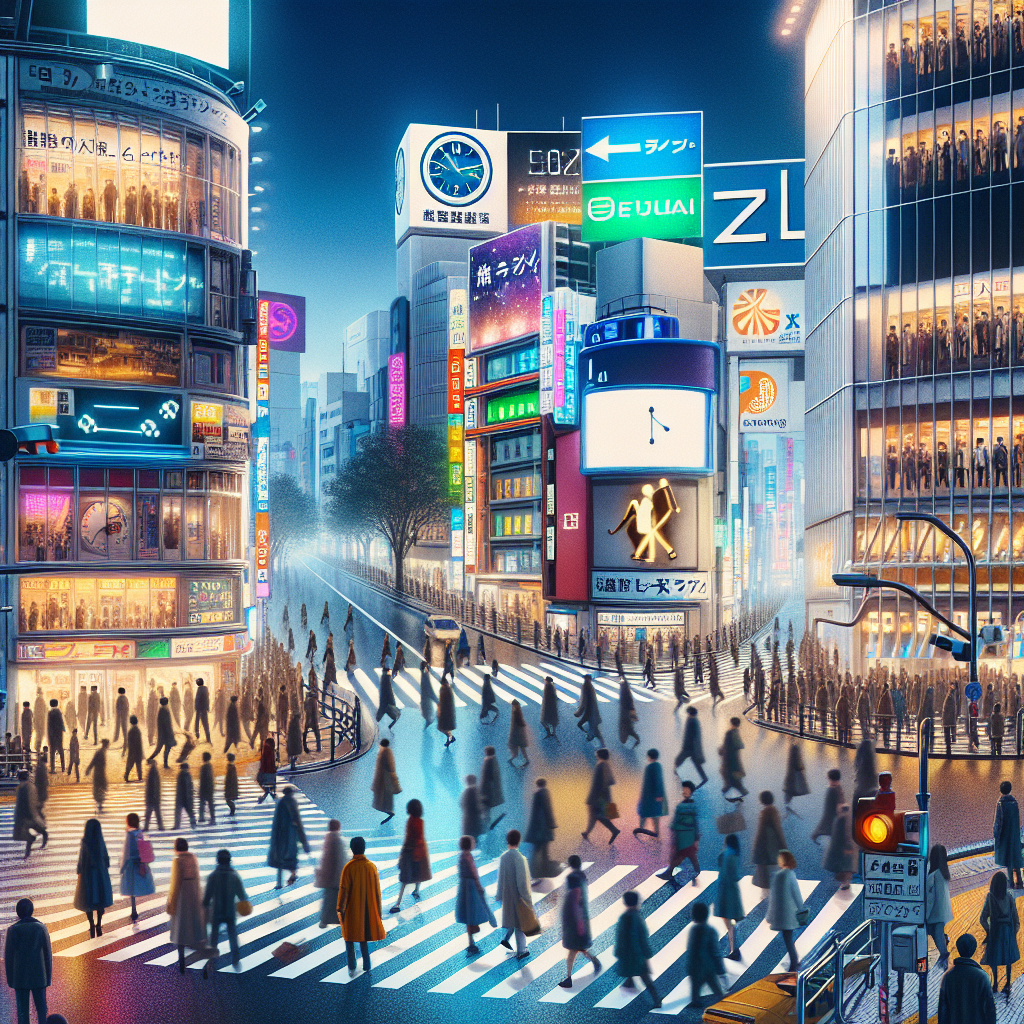
Shibuya Scramble Echo: A Short Novel of Temporal Folds
The ramen tasted of static and déjà vu. Not the rich, umami-laden broth I craved amidst the pulsating heart of Shibuya Crossing, but a thin, electric tang, a premonition of timelines collapsing. I choked it down, the synthetic aftertaste clinging to my tongue like a warning.
The digital clock on the towering Tsutaya screen flickered: 17:59:59. Again. It had been 17:59:59 for what felt like an eternity. Or perhaps a fraction of a second, stretched thin and infinitely repeating.
Yesterday – or was it tomorrow? – I’d been a salaryman, rushing home to a wife and kids in Saitama. The day before, a struggling musician, hawking CDs outside Shibuya Station. Before that… a vacant-eyed tourist, lost in the neon labyrinth.
Now, I was simply… aware. Aware of the loop, the glitch in the matrix, the temporal fold that had ensnared Shibuya Crossing in its relentless embrace. Everyone else was oblivious, caught in their pre-programmed routines, extras in my personal Groundhog Day hellscape.
I tried to break free. I boarded a train to Shinjuku. The train never arrived. I attempted to leave Shibuya on foot. Invisible barriers materialized, forcing me back into the swirling vortex of humanity.
The Glitch
The ramen stand owner, a stoic man with eyes that seemed to hold the weight of centuries, noticed me. He always noticed me. Each iteration, he’d offer me the same knowing glance, the same nearly imperceptible nod. Was he another prisoner? A gatekeeper? Or simply a figment of my fractured consciousness?
Today, he spoke. “The echo grows stronger,” he rasped, his voice like gravel grinding against stone. “The fold deepens. You are not the only one who hears it.”
He pointed with a greasy chopstick towards the Hachiko statue, where a young woman sat sketching in a worn leather-bound notebook. She looked up, her eyes meeting mine. Recognition flared, followed by a chilling understanding. She knew.
The Others
We found each other easily, drawn together by the magnetic pull of shared awareness. There was the salaryman, haunted by the phantom weight of his briefcase; the musician, his guitar gathering dust in a corner of his cramped apartment; the tourist, clutching a crumpled map of a city that no longer existed.
Each of us remembered different lives, different timelines, all converging at this one specific point: Shibuya Crossing, 17:59:59.
“What do we do?” the tourist asked, his voice trembling.
“We break the loop,” the musician said, strumming a discordant chord on an imaginary guitar. “We rewrite the program.”
The Attempt
We decided to disrupt the pattern, to deviate from the established script. At 17:59:58, we stood in the center of the crossing, facing each other, a small island of defiance in a sea of oblivious humanity. As the clock ticked over, we screamed. A collective, primal scream of frustration, fear, and desperate hope.
The world shimmered. The neon lights flickered. The ground beneath our feet vibrated. For a moment, I thought we’d succeeded. Then, the clock reset. 17:59:59.
The ramen still tasted of static.
The Acceptance (Maybe)
We continue to meet at the Hachiko statue, each iteration bringing new faces, new memories, new fragments of shattered timelines. We share our stories, our theories, our fleeting hopes.
Perhaps there is no escape. Perhaps this is our purgatory, our eternal Shibuya Scramble. But even in the face of infinite repetition, there is a strange comfort in knowing that we are not alone. We are the echoes, the glitches, the forgotten souls caught in the temporal fold. And we will keep screaming, keep remembering, keep searching for a way out, even if that way out doesn’t exist.
The clock ticks on. 17:59:59. And then… again.
