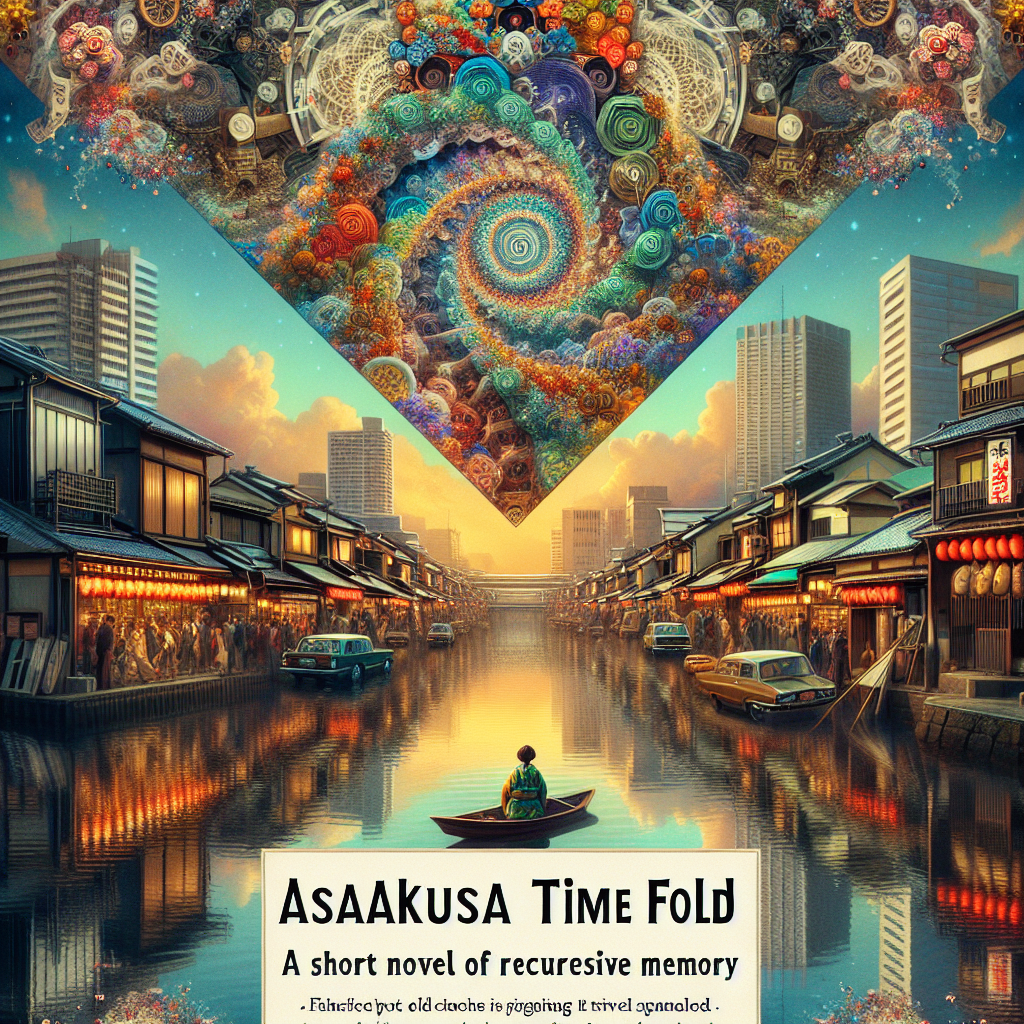
Asakusa Time Fold: A Short Novel of Recursive Memory
The green tea tasted of dust and forgotten prayers. Not the vibrant, earthy brew I craved amidst the ancient calm of Asakusa, but a dry, almost papery residue, a ghost of memories never fully formed. I sat on the steps of Sensō-ji Temple, the scent of incense a thin veil over the metallic tang in the air, a premonition of temporal slippage.
My name is Kenji, though names feel increasingly flimsy these days, like paper lanterns in a typhoon. I’m caught in a loop, a recursive echo, centered on this very spot. I know it’s a loop because I’ve seen the old woman with the persimmon candy drop it exactly the same way three times now. The first time, I helped her pick it up. The second time, I watched, a detached observer. This time, I felt a compulsion to act, a tightening in my chest.
It began subtly. A flicker in the corner of my eye, a sense of déjà vu so intense it felt like a physical blow. Then, the repetitions became blatant, undeniable. Conversations replaying verbatim, events unfolding with impossible precision. I tried to break the pattern. I took a different route to the temple, ordered soba instead of ramen, even attempted to leave Tokyo altogether. Nothing worked. The loop tightened, pulling me back to Asakusa, to the steps of Sensō-ji, to the falling persimmon.
The Glitch in the Algorithm
I started documenting everything. Every detail, every nuance. I filled notebooks with observations, sketches, and calculations. I reasoned that if I could understand the mechanics of the loop, I could find a way to escape it. Was it a technological anomaly? A psychic phenomenon? Or simply a manifestation of my own fractured psyche?
My research led me down rabbit holes of quantum physics, string theory, and ancient Shinto beliefs. I spoke to physicists, monks, and conspiracy theorists. Each offered a different explanation, none of them satisfactory. The only common thread was a sense of unease, a recognition that something was fundamentally wrong with the fabric of reality.
One evening, while pouring over my notes, I noticed a recurring symbol. It appeared in the patterns of the temple tiles, in the calligraphy on the lanterns, even in the way the steam rose from my tea. It was a stylized representation of an ouroboros, a serpent eating its own tail. A symbol of cyclical time, of endless repetition.
Breaking the Chain
The ouroboros became my obsession. I studied its history, its symbolism, its occult significance. I learned that it represented not only endless repetition but also the potential for self-destruction, the possibility of breaking the cycle through an act of radical transformation. Could that transformation be me?
The next time the old woman dropped her persimmon candy, I did something different. Instead of helping her or ignoring her, I sat beside her and offered her one of my own. A small, insignificant act, but it felt like a rupture in the continuum. She looked at me, her eyes crinkled with confusion, then smiled, a genuine, unscripted smile. “Arigato,” she said, her voice raspy with age. “Thank you.”
The metallic tang in the air began to fade. The feeling of déjà vu receded, replaced by a sense of…newness. I looked around. The temple seemed brighter, the sounds of the city clearer. Had I broken the loop? Was I finally free?
I don’t know for sure. But as I walked away from Sensō-ji, I felt a lightness I hadn’t felt in a long time. Maybe the key to escaping the loop wasn’t understanding its mechanics but embracing the unexpected, choosing kindness over repetition. Maybe the ouroboros could be defeated not by destroying itself, but by letting go of its own tail. Only time will tell.
